Growth hormone secretagogues (GHSs) are a class of compounds that stimulate the release of growth hormone (GH) from the pituitary gland. Growth hormone-releasing peptides (GHRP) 2 and 6 are both synthetic GHSs. They mimic the action of the endogenous GHS, ghrelin, and have allowed researchers to better study the consequences of receptor activation, as well as explore its therapeutic potential. This article will explain what the endogenous GHSs do, what these synthetic compounds are, and how they could be useful from a medical and research perspective.
Endogenous Growth Hormone Secretagogues (GHS)
The main substances produced by the body that stimulate the secretion of GH are ghrelin (lenomorelin) and growth hormone-releasing hormone (GHRH/somatocrinin)1,2. These hormones act synergistically to fine-tune the release of growth hormone. Understanding these endogenous hormones will help us to better understand what the synthetic peptides, GHRPs 2 and 6, are capable of, as they can all activate the same receptor.
GHS Function and Mechanism of Action
Ghrelin binds to GHSR1a, also known as the ghrelin receptor, leading to the stimulation of appetite, growth hormone release, and regulation of metabolism. GHRH binds to GHRH receptors (GHRHR) to promote the secretion of GH from the pituitary gland, but can also bind to ghrelin receptors, activating ghrelin’s signalling pathways3. The expression of these secretagogues is influenced by a variety of factors, such as:
- Nutritional and metabolic states: Fasting or starvation significantly alters ghrelin and GHRH expression, although different species and sexes exhibit different changes in the levels of these GHSs in response to fasting. Prolonged fasting results in further changes in GHS levels but generally increases the body’s sensitivity to them4–6.
- Age: Growth hormone levels are known to decrease with increasing age, and this natural decline is thought to promote longevity7,8.
- Thyroid hormone status: Hypothyroidism increases ghrelin expression and decreases the body’s response to GHRH9,10, while hyperthyroidism decreases ghrelin and GHRH expression11.
- Hormones: Several hormones work together to regulate GHS levels. Ghrelin and GHRH act synergistically to increase each other’s levels12, while somatostatin is a hormone that inhibits the release of growth hormone and ghrelin13. Ghrelin and GHRH also interact with other hormones involved in energy homeostasis, such as insulin and leptin, both directly and indirectly, to carefully regulate hunger, metabolism, and growth14,15.
The purpose of ghrelin is to help regulate energy homeostasis by stimulating appetite. It also influences energy homeostasis, lipid metabolism, gastric motility, stomach acid secretion, and can affect cardiovascular function, immune response, cell proliferation, and cognition1,16,17.
In addition to regulating growth, metabolism, and tissue development, GHRH modulates the immune system, helps to regulate the reproductive system, influences mood, circadian rhythm, appetite, and is neuroprotective18–22.
These secretagogues have a diverse range of activities and play an important role in the maintenance of homeostasis. Their ability to stimulate the release of GH is the main mechanism through which they exert their activities, and the overlap between their actions may be in part due to both being able to bind ghrelin receptors.
As mentioned earlier, these are not the only compounds that can bind and activate ghrelin receptors. Researchers have synthesised peptides capable of targeting and agonising this same receptor.
GHRP-2 and GHRP-6
GHRP-2 (pralmorelin) and GHRP-6 (growth hormone-releasing hexapeptide) are both synthetic peptides that act in a similar way to ghrelin. They bind to ghrelin receptors to stimulate the secretion of growth hormone. They do not bind to GHRHR. They were synthesised to enhance GH secretion in pharmacological applications and to develop novel therapeutic agents with diverse effects.
Despite the same mode of action, GHRP-2 and GHRP-6 are not interchangeable, and we will review what is known about each of these with regard to their similarities and differences.
Structure
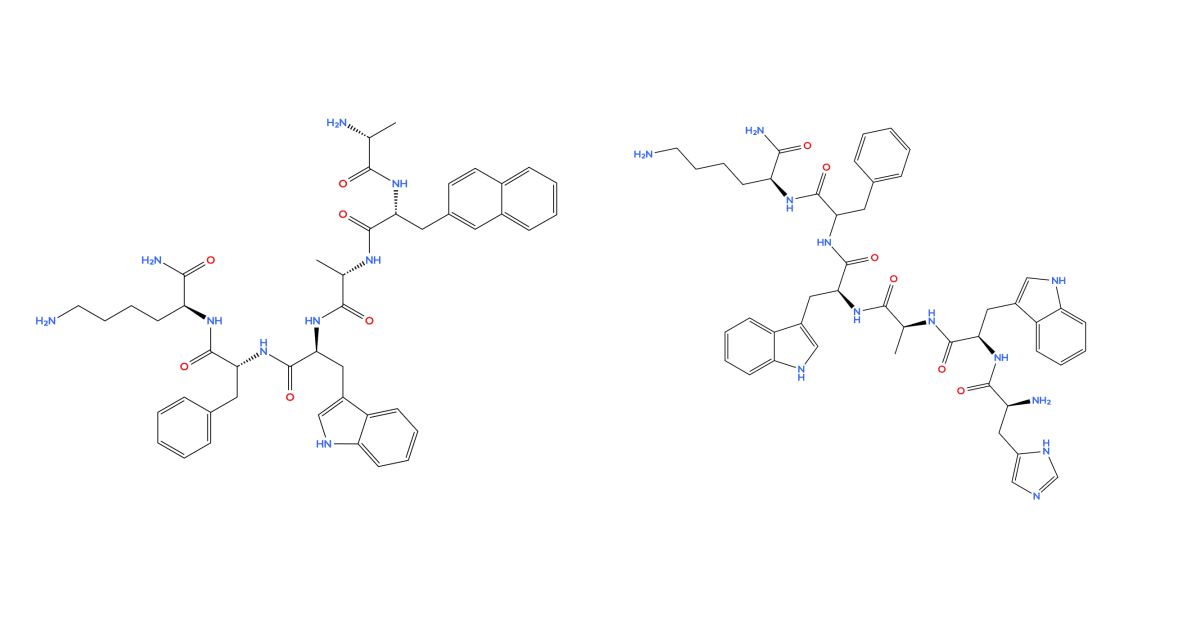
Both GHRP-2 and GHRP-6 are made up of 6 amino acids. Their sequences are as follows:
GHRP-2: H-D-Ala-D-2-Nal-Ala-Trp-D-Phe-Lys-NH₂
GHRP-6: His-D-Trp-Ala-Trp-D-Phe-Lys-NH₂
Where GHRP-6 has an N-terminal histidine, followed by D-Trp, GHRP-2 has D-Ala and a D-2-Nal, which confer stronger activity and higher stability.
Mechanism of action: Similarities
These peptides both work by:
- Binding to the ghrelin receptor in the hypothalamus and pituitary, the activation of which causes a release of GH23.
- Interacting synergistically with endogenous GHRH to potentiate GH release24.
- Binding to CD36, which triggers the PI3K/AKT and antioxidant pathways, promotes cell survival and reduces oxidative stress23.
- Binding to ghrelin receptors in the gut to increase gastrointestinal motility via appetite stimulation25,26.
- Modulating various signalling pathways to decrease fibrosis and improve scar quality27,28.
- Elevating IGF-1 levels, which alters metabolism and promotes cell growth and survival29,30.
When administered together, they do not produce a more pronounced effect on GH release and can desensitise each other, which suggests strong similarity in their signalling31. Despite this similarity, they differ in their potency and ability to bind to other receptors.
Mechanism of Action: Key Differences
GHRP-2
- Orexigenic (appetite-stimulating) activity is considered to be milder, although there are no studies directly comparing this effect with that of GHRP-6.
- Known to elicit a stronger and more consistent release of GH32.
- Acts as a ghrelin receptor agonist with no negative modulation.
- Increases intracellular cAMP levels in somatotrophs33.
- GH release is inhibited by GHRH receptor antagonists, suggesting that it may bind to a receptor linked to the GHRH system33.
GHRP-6
- Strongly associated with orexigenic activity via ghrelin-like signalling34
- Causes a slightly weaker GH release compared to GHRP-2, with variable efficacy
- Agonises the ghrelin receptor but can also act as a negative modulator of ghrelin signalling under certain circumstances35.
- Causes GH release without increasing cAMP33.
- Unaffected by GHRH receptor antagonists33.
Therapeutic and Experimental Applications
Because of their mechanism of action and similarity to endogenous secretagogues, they have been investigated for their uses in treating:
- GH deficiency and growth disorders:
- GHRP-2 is a potent GH-releasing agent and is used diagnostically for GH deficiency and hypothalamic-pituitary disorders36. In GH-deficient children, it increased GH secretion and growth velocity; however, it did not increase IGF-1 significantly, and the effects were short-lived37.
- GHRP-6 is used for diagnosing GH deficiency but is not currently used in treatments38.
- Cachexia, anorexia, and low appetite: GHRP-2 and GHRP-6 both increase hunger and food intake34,39.
- Inflammation and organ/tissue damage: Since both of these peptides act at CD36, they are both able to modulate the immune response and reduce inflammation.
- GHRP-2 has demonstrated an ability to reduce inflammation in models of arthritis40, sepsis-induced lung injury41, models of atherosclerosis42, and rotator cuff tear28 and has demonstrated myotropic, antifibrotic, and cytoprotective activity in various tissues23.
- GHRP-6 prevented damage in heart failure models43, reduced damage in ischemia-reperfusion44 and significantly reduced scarring in liver cirrhosis45, while topical application accelerated wound closure, reduced inflammation, and improved the aesthetic outcome46.
- Muscle wasting: Ghrelin receptor signalling, which is activated by these peptides, generally promotes food intake and protects against muscle wastage.
- GHRP-2 improved the daily weight gain of animals without increasing their food intake47.
- A GHRP-6-biotin conjugate improved the condition of muscles by stimulating myocyte differentiation, increasing IGF-1 and collagen expression, and enhancing metabolic activity in muscles48.
- Gastroparesis and GI injury: The anti-inflammatory and anti-apoptotic activity of these peptides confers protection to the gut, while the activation of ghrelin receptors in the brain stimulates gut motility. One study found that GHRP-6 was able to promote gastric emptying in diabetic mice with gastroparesis25.
Safety, Tolerability and Limitations
Known short-term effects include an increase in appetite, which may be considered a benefit or adverse effect depending on why it is being administered.
- GHRP-2 has exhibited a low incidence of adverse effects and is currently approved as a diagnostic GH secretagogue. Its use in any other treatments is limited to research settings.
- GHRP-6 has very limited data regarding safety due to a lack of human studies. It is used in diagnostics to test for growth hormone deficiency in adults, where it is considered safer than the insulin tolerance test.
Both of these peptides are banned by the WADA due to their potential performance-enhancing effects.
Although these peptides show promise in multiple experimental therapeutic areas, it is important that we do not preemptively assume that they are safe to use. There are very few large-scale or long-term clinical studies on these peptides, so we do not know much about their safety. Ideally, we would want to see a greater number of long-term studies on larger populations before we can begin to confidently administer them as part of any treatment.
Conclusion
GHRP-2 and GHRP-6 are both known to bind to GHSR1a to stimulate the release of GH, but despite this similarity, their efficacy and pathways still differ, giving GHRP-2 stronger GH-releasing activity than GHRP-6.
GHRP-2 and 6 are used in the diagnosis of GH deficiency, but these peptides are not currently approved for any treatments. Studies so far have demonstrated some evidence of their potential to provide certain benefits, although most of these studies are on animal models and cannot be directly translated into the results that we would expect to see in humans.
Further research will dictate the role of GHRP-2 and GHRP-6 in endocrine therapeutics. If they continue to consistently demonstrate useful, reproducible results in clinical tests, they may one day find their way into mainstream medical treatments.
Buy GHRP-2 and GHRP-6 for your research from us.
References
- Jiao ZT, Luo Q. Molecular Mechanisms and Health Benefits of Ghrelin: A Narrative Review. Nutrients. 2022;14(19):4191. doi:10.3390/nu14194191
- Montero-Hidalgo AJ, del Rio-Moreno M, Pérez-Gómez JM, Luque RM, Kineman RD. Update on regulation of GHRH and its actions on GH secretion in health and disease. Rev Endocr Metab Disord. 2025;26(3):305-320. doi:10.1007/s11154-025-09943-y
- Casanueva FF, Camiña JP, Carreira MC, Pazos Y, Varga JL, Schally AV. Growth hormone-releasing hormone as an agonist of the ghrelin receptor GHS-R1a. Proc Natl Acad Sci. 2008;105(51):20452-20457. doi:10.1073/pnas.0811680106
- Muller AF, Lamberts SWJ, Janssen JAMJL, et al. Ghrelin drives GH secretion during fasting in man. Eur J Endocrinol. 2002;146(2):203-207. doi:10.1530/eje.0.1460203
- Luque RM, Park S, Kineman RD. Severity of the Catabolic Condition Differentially Modulates Hypothalamic Expression of Growth Hormone-Releasing Hormone in the Fasted Mouse: Potential Role of Neuropeptide Y and Corticotropin-Releasing Hormone. Endocrinology. 2007;148(1):300-309. doi:10.1210/en.2006-0592
- Miles TK, Silva Moreira AR, Allensworth-James ML, et al. Sex differences in somatotrope response to fasting: biphasic responses in male mice. J Endocrinol. 2020;247(3):213-224. doi:10.1530/JOE-20-0275
- Bartke A. Growth Hormone and Aging: Updated Review. World J Mens Health. 2019;37(1):19. doi:10.5534/wjmh.180018
- Aguiar-Oliveira MH, Bartke A. Growth Hormone Deficiency: Health and Longevity. Endocr Rev. 2019;40(2):575-601. doi:10.1210/er.2018-00216
- Gjedde S, Vestergaard ET, Gormsen LC, et al. Serum Ghrelin Levels Are Increased in Hypothyroid Patients and Become Normalized by l-Thyroxine Treatment. J Clin Endocrinol Metab. 2008;93(6):2277-2280. doi:10.1210/jc.2007-2619
- WILLIAMS T, MAXON H, THORNER MO, FROHMAN LA. Blunted Growth Hormone (GH) Response to GH-Releasing Hormone in Hypothyroidism Resolves in the Euthyroid State*. J Clin Endocrinol Metab. 1985;61(3):454-456. doi:10.1210/jcem-61-3-454
- Molica P, Nascif SO, Correa-Silva SR, de Sá LBPC, Vieira JGH, Lengyel AMJ. Effects of ghrelin, GH-releasing peptide-6 (GHRP-6) and GHRH on GH, ACTH and cortisol release in hyperthyroidism before and after treatment. Pituitary. 2010;13(4):315-323. doi:10.1007/s11102-010-0238-3
- Hataya Y, Akamizu T, Takaya K, et al. A Low Dose of Ghrelin Stimulates Growth Hormone (GH) Release Synergistically with GH-Releasing Hormone in Humans. J Clin Endocrinol Metab. 2001;86(9):4552-4555. doi:10.1210/jcem.86.9.8002
- Barkan AL, Dimaraki EV, Jessup SK, Symons KV, Ermolenko M, Jaffe CA. Ghrelin Secretion in Humans Is Sexually Dimorphic, Suppressed by Somatostatin, and Not Affected by the Ambient Growth Hormone Levels. J Clin Endocrinol Metab. 2003;88(5):2180-2184. doi:10.1210/jc.2002-021169
- Skoracka K, Hryhorowicz S, Schulz P, et al. The role of leptin and ghrelin in the regulation of appetite in obesity. Peptides. 2025;186:171367. doi:10.1016/j.peptides.2025.171367
- Gagnon J, Anini Y. Insulin and Norepinephrine Regulate Ghrelin Secretion from a Rat Primary Stomach Cell Culture. Endocrinology. 2012;153(8):3646-3656. doi:10.1210/en.2012-1040
- Yakabi K, Kawashima J, Kato S. Ghrelin and gastric acid secretion. World J Gastroenterol. 2008;14(41):6334-6338. doi:10.3748/wjg.14.6334
- Jiao Q, Du X, Li Y, et al. The neurological effects of ghrelin in brain diseases: Beyond metabolic functions. Neurosci Biobehav Rev. 2017;73:98-111. doi:10.1016/j.neubiorev.2016.12.010
- Khorram O, Yeung M, Vu L, Yen SSC. Effects of [Norleucine27]Growth Hormone-Releasing Hormone (GHRH) (1–29)-NH2 Administration on the Immune System of Aging Men and Women1. J Clin Endocrinol Metab. 1997;82(11):3590-3596. doi:10.1210/jcem.82.11.4363
- Pérez-Gómez JM, Montero-Hidalgo AJ, Luque RM. GHRH and reproductive systems: Mechanisms, functions, and clinical implications. Rev Endocr Metab Disord. 2025;26(3):507-524. doi:10.1007/s11154-024-09931-8
- Recinella L, Chiavaroli A, Orlando G, et al. Effects of growth hormone-releasing hormone receptor antagonist MIA-602 in mice with emotional disorders: a potential treatment for PTSD. Mol Psychiatry. 2021;26(12):7465-7474. doi:10.1038/s41380-021-01228-5
- Vaccarino FJ, Sovran P, Baird JP, Ralph MR. Growth hormone-releasing hormone mediates feeding-specific feedback to the suprachiasmatic circadian clock. Peptides. 1995;16(4):595-598. doi:10.1016/0196-9781(95)00018-F
- Liu Y, Fu R, Jia H, Yang K, Ren F, Zhou MS. GHRH and its analogues in central nervous system diseases. Rev Endocr Metab Disord. 2025;26(3):427-442. doi:10.1007/s11154-024-09920-x
- Berlanga-Acosta J, Abreu-Cruz A, Barco Herrera DG del, et al. Synthetic Growth Hormone-Releasing Peptides (GHRPs): A Historical Appraisal of the Evidences Supporting Their Cytoprotective Effects. Clin Med Insights Cardiol. 2017;11:1179546817694558. doi:10.1177/1179546817694558
- Adams EF, Lei T, Buchfelder M, Bowers CY, Fahlbusch R. Protein kinase C-dependent growth hormone releasing peptides stimulate cyclic adenosine 3’,5’-monophosphate production by human pituitary somatotropinomas expressing gsp oncogenes: evidence for crosstalk between transduction pathways. Mol Endocrinol. 1996;10(4):432-438. doi:10.1210/mend.10.4.8721987
- Qiu WC, Wang ZG, Wang WG, Yan J, Zheng Q. Gastric motor effects of ghrelin and growth hormone releasing peptide 6 in diabetic mice with gastroparesis. World J Gastroenterol. 2008;14(9):1419. doi:10.3748/wjg.14.1419
- Mericq V, Cassorla F, Bowers CY, Avila A, Gonen B, Merriam GR. Changes in appetite and body weight in response to long-term oral administration of the ghrelin agonist GHRP-2 in growth hormone deficient children. J Pediatr Endocrinol Metab JPEM. 2003;16(7):981-985. doi:10.1515/jpem.2003.16.7.981
- Mendoza-Marí Y, Fernández-Mayola M, Vázquez-Blomquist D, et al. GHRP-6 , a novel candidate for prevention and treatment of fibrotic disorders. In: 2017. Accessed January 31, 2026. https://www.semanticscholar.org/paper/GHRP-6-%2C-a-novel-candidate-for-prevention-and-of-Mendoza-Mar%C3%AD-Fern%C3%A1ndez-Mayola/490c3715b627e5b67c1b5a9c41ce9d8a925642b4
- Li Y, Yao L, Zhang C, et al. Growth Hormone–Releasing Peptide 2 May Be Associated With Decreased M1 Macrophage Production and Increased Histologic and Biomechanical Tendon-Bone Healing Properties in a Rat Rotator Cuff Tear Model. Arthroscopy. 2025;41(7):2224-2233. doi:10.1016/j.arthro.2024.11.094
- Bowers CY, Granda R, Mohan S, Kuipers J, Baylink D, Veldhuis JD. Sustained Elevation of Pulsatile Growth Hormone (GH) Secretion and Insulin-Like Growth Factor I (IGF-I), IGF-Binding Protein-3 (IGFBP-3), and IGFBP-5 Concentrations during 30-Day Continuous Subcutaneous Infusion of GH-Releasing Peptide-2 in Older Men and Women. J Clin Endocrinol Metab. 2004;89(5):2290-2300. doi:10.1210/jc.2003-031799
- Sigalos JT, Pastuszak AW, Allison A, et al. Growth Hormone Secretagogue Treatment in Hypogonadal Men Raises Serum Insulin-Like Growth Factor-1 Levels. Am J Mens Health. 2017;11(6):1752-1757. doi:10.1177/1557988317718662
- Cheng J, Wu TJ, Butler B, Cheng K. Growth hormone releasing peptides: A comparison of the growth hormone releasing activities of GHRP-2 and GHRP-6 in rat primary pituitary cells. Life Sci. 1997;60(16):1385-1392. doi:10.1016/S0024-3205(96)00655-8
- Roh SG, Lee HG, Phung LT, Hidari H. Characterization of Growth Hormone Secretion to Growth Hormone-releasing Peptide-2 in Domestic Animals – A Review. Asian-Australas J Anim Sci. 2002;15(5):757-766. doi:10.5713/ajas.2002.757
- The effects of GH-releasing peptide-6 (GHRP-6) and GHRP-2 on intracellular adenosine 3′,5′-monophosphate (cAMP) levels and GH secretion in ovine and rat somatotrophs in: Journal of Endocrinology Volume 148 Issue 2 (1996). Accessed November 18, 2025. https://joe.bioscientifica.com/view/journals/joe/148/2/joe_148_2_003.xml
- Poelman R, Le May MV, Schéle E, Stoltenborg I, Dickson SL. Intranasal Delivery of a Ghrelin Mimetic Engages the Brain Ghrelin Signaling System in Mice. Endocrinology. 2025;166(3):bqae166. doi:10.1210/endocr/bqae166
- Holst B, Brandt E, Bach A, Heding A, Schwartz TW. Nonpeptide and Peptide Growth Hormone Secretagogues Act Both as Ghrelin Receptor Agonist and as Positive or Negative Allosteric Modulators of Ghrelin Signaling. Mol Endocrinol. 2005;19(9):2400-2411. doi:10.1210/me.2005-0059
- Suzuki S, Ruike Y, Ishiwata K, et al. Clinical Usefulness of the Growth Hormone–Releasing Peptide-2 Test for Hypothalamic-Pituitary Disorder. J Endocr Soc. 2022;6(8):bvac088. doi:10.1210/jendso/bvac088
- Mericq V, Cassorla F, Salazar T, et al. Effects of Eight Months Treatment with Graded Doses of a Growth Hormone (GH)-Releasing Peptide in GH-Deficient Children1. J Clin Endocrinol Metab. 1998;83(7):2355-2360. doi:10.1210/jcem.83.7.4969
- Popovic V, Leal A, Micic D, et al. GH-releasing hormone and GH-releasing peptide-6 for diagnostic testing in GH-deficient adults. Lancet. 2000;356(9236):1137-1142. doi:10.1016/S0140-6736(00)02755-0
- Tschöp M, Statnick MA, Suter TM, Heiman ML. GH-Releasing Peptide-2 Increases Fat Mass in Mice Lacking NPY: Indication for a Crucial Mediating Role of Hypothalamic Agouti-Related Protein. Endocrinology. 2002;143(2):558-568. doi:10.1210/endo.143.2.8633
- Granado M, Priego T, Martín A, Villanúa Á, López-Calderón A, López-Calderón A. Anti-inflammatory Effect of the Ghrelin Agonist Growth Hormone-releasing Peptide-2 (ghrp-2) in Arthritic Rats. Accessed November 18, 2025. https://www.semanticscholar.org/paper/Anti-inflammatory-Effect-of-the-Ghrelin-Agonist-in-Granado-Priego/4282351b1660213d2c84564beb276691d68aabe2?p2df
- Li G, Li J, Zhou Q, Song X, Liang H, Huang L. Growth hormone releasing peptide-2, a ghrelin agonist, attenuates lipopolysaccharide-induced acute lung injury in rats. Tohoku J Exp Med. 2010;222(1):7-13. doi:10.1620/tjem.222.7
- Titterington JS, Sukhanov S, Higashi Y, Vaughn C, Bowers C, Delafontaine P. Growth hormone-releasing peptide-2 suppresses vascular oxidative stress in ApoE-/- mice but does not reduce atherosclerosis. Endocrinology. 2009;150(12):5478-5487. doi:10.1210/en.2009-0283
- Berlanga-Acosta J, Cibrian D, Valiente-Mustelier J, et al. Growth hormone releasing peptide-6 (GHRP-6) prevents doxorubicin-induced myocardial and extra-myocardial damages by activating prosurvival mechanisms. Front Pharmacol. 2024;15:1402138. doi:10.3389/fphar.2024.1402138
- Cibrián D, Ajamieh H, Berlanga J, et al. Use of growth-hormone-releasing peptide-6 (GHRP-6) for the prevention of multiple organ failure. Clin Sci. 2006;110(5):563-573. doi:10.1042/CS20050374
- Berlanga-Acosta J, Vazquez-Blomquist D, Cibrián D, et al. Growth Hormone Releasing Peptide 6 (GHRP6) reduces liver fibrosis in CCl4 chronically intoxicated rats. Biotecnol Apl. 2012;29(2):60-72.
- Mendoza Marí Y, Fernández Mayola M, Aguilera Barreto A, et al. Growth Hormone-Releasing Peptide 6 Enhances the Healing Process and Improves the Esthetic Outcome of the Wounds. Plast Surg Int. 2016;2016:1-11. doi:10.1155/2016/4361702
- Phung LT, Inoue H, Nou V, et al. The effects of growth hormone-releasing peptide-2 (GHRP-2) on the release of growth hormone and growth performance in swine. Domest Anim Endocrinol. 2000;18(3):279-291. doi:10.1016/s0739-7240(00)00050-3
- Lim CJ, Jeon JE, Jeong SK, et al. Growth hormone-releasing peptide-biotin conjugate stimulates myocytes differentiation through insulin-like growth factor-1 and collagen type I. BMB Rep. 2015;48(9):501-506. doi:10.5483/bmbrep.2015.48.9.258