
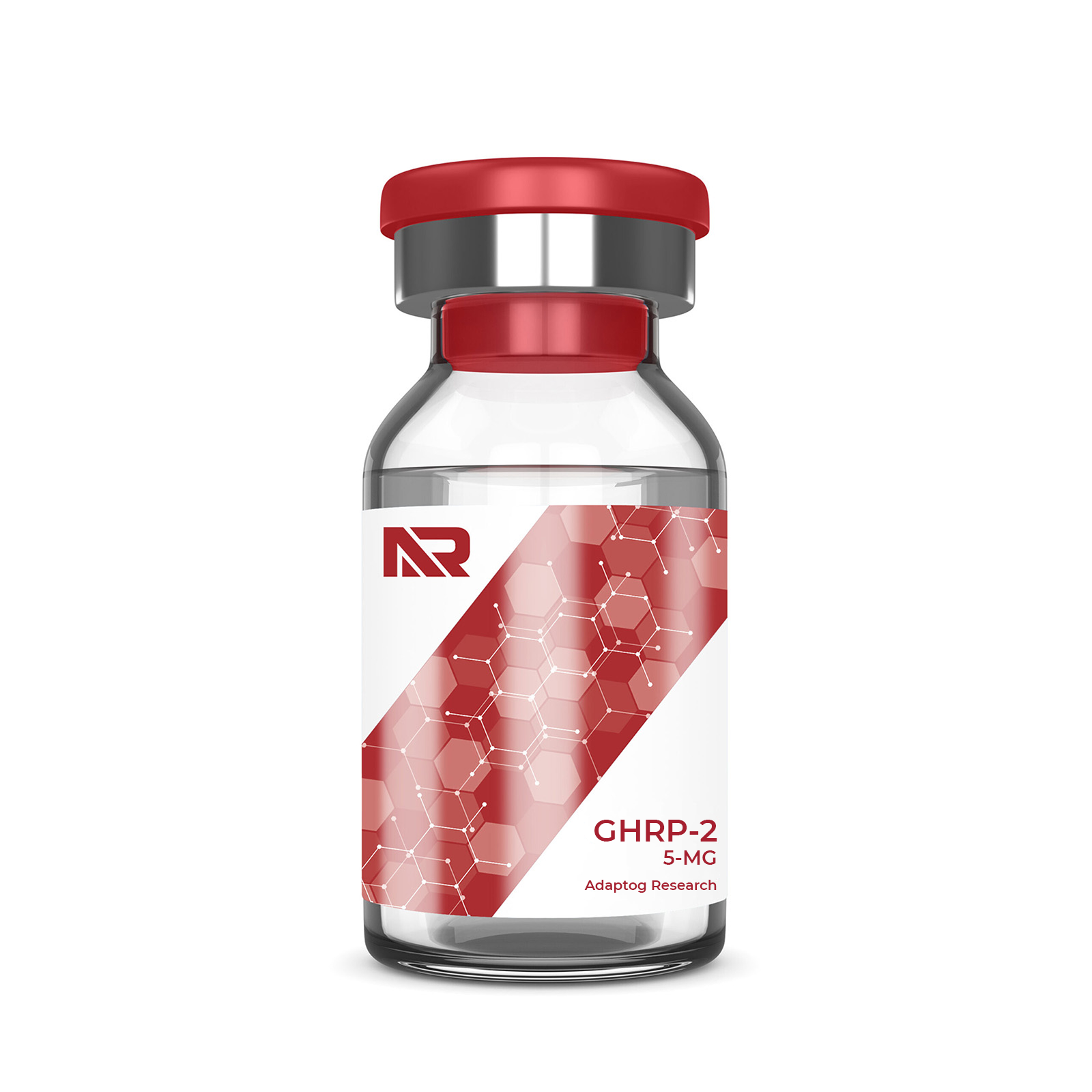
GHRP-2 (Growth Hormone Releasing Peptide-2) is a synthetic peptide that potently stimulates the secretion of growth hormone (GH) by binding to the growth hormone secretagogue receptor (GHSR1a), mimicking the action of ghrelin. Although its name would suggest its activity centres around the stimulation of GH secretion, it has more extensive therapeutic applications.
Mechanism of Action
GHRP-2 exerts its activity through:
- GHSR1a agonism: It activates the same receptor as ghrelin, the hunger hormone, which then stimulates the hypothalamus and pituitary to secrete GH [1].
- Hypothalamic effects: It stimulates hormones that increase appetite and promote anabolic metabolism [2,3].
- Synergy with GHRH (Growth Hormone Releasing Hormone): GHRP-2 and GHRH act synergistically to promote GH secretion. This synergy induces the secretion of GH to a greater extent than either peptide could stimulate alone. Not only is the quantity of GH increased, but also the duration it is secreted. The extent of this effect is influenced by factors such as age, sex, and body composition, with less of a synergistic effect being seen with increasing age and visceral fat, but increasing with IGF-1 levels [4].
- Direct effects on target tissues: GHRP-2 can act directly on myocytes to suppress muscle atrophy genes [5]. It also acts on immune cells to reduce the release of pro-inflammatory cytokines and nitrate production [6].
Therapeutic Potential
Due to its effect on these pathways, it is being investigated for its potential use as a therapeutic peptide for the treatment of:
- GH deficiency and growth disorders: It has been used to stimulate GH and IGF-1 secretion in children and animals with growth retardation, improving their growth and promoting muscle protein [7,8].
- Cachexia and anorexia nervosa: It increases appetite, food intake, and body weight [2]. It was found to increase the appetite of healthy men by approximately 37% [9]. One study found it was useful in increasing the body weight of a patient with anorexia nervosa [10]. In animal models with colon cancer receiving chemotherapy, it increased appetite, helping to reduce weight loss during treatment [11].
- Inflammation and organ damage: In models of liver injury and arthritis, it exerted anti-inflammatory effects, decreasing cytokine production and reducing tissue damage [6,12].
- Tendon-bone wounds: Rats with tendon-bone injury were treated with GHRP-2, and researchers found that healing was significantly improved [13].
- Heart disease: GHRP-2 improves cardiac function and suppresses apoptosis in heart failure and ischemic models [14].
Safety
GHRP-2 is considered generally well-tolerated, with few adverse events being reported in clinical trials. It has been tested at doses of up to 3 µg/kg in children with GH deficiency for up to eight months, and no side effects or toxicity were reported [8]. In a clinical study involving healthy adults, no adverse effects were observed when GHRP-2 was administered intravenously [9].
How It Compares to GHRP-6
GHRP-2 and GHRP-6 are both synthetic peptides that stimulate the secretion of GH by binding to the GHSR1a receptor; however, there are differences in their proposed applications due to variations in their signalling pathways.
GHRP-2 is a more potent stimulator of GH secretion when compared to GHRP-615, and it is currently used in GH-related therapies. In addition to stimulating growth, research has also focused on its application in treating conditions involving inflammation.
Research on GHRP-6 has highlighted its cardioprotective activity due to its ability to reduce inflammation and fibrosis and preserve heart function [16].
GHRP-2 is approved in Japan for use as a diagnostic agent in cases of suspected growth hormone secretion deficiency, while GHRP-6 is not approved as a drug. Both are banned by the WADA (World Anti-Doping Agency), as they are considered performance enhancers.
Data Sheet
Application: Research on muscle and bone growth, appetite, inflammation, organ protection, cardioprotection, and healing.
| Application
Research on muscle and bone growth, appetite, inflammation, organ protection, cardioprotection, and healing. |
| CAS Number
158861-67-7 |
| Molecular Weight
817.99 |
| Sequence
H-D-Ala-D-2Nal-Ala-Trp-D-Phe-Lys-NH₂ |
| Chemical Formula
C45H55N9O6 |
| Synonyms
Pralmorelin, KP-102, pralmorelina |
| Storage
Keep refrigerated at 2-8°C until use. For long-term storage, keep at -20°C. |
| Reconstitution
Reconstitute in sterile water. The reconstituted solution is stable for up to one week at 2-8°C. |
| Organoleptic Profile
White to off-white lyophilised powder |
| Physical Form
Solid |
Conclusion
The synthetic peptide, GHRP-2, stimulates GH release by acting on the same receptor that the natural hormone, ghrelin, acts on. This causes changes in the body such as increased appetite, a reduction in inflammation, an increase in muscle and bone growth, and increased tissue repair. It acts on the same receptor as a similar peptide, GHRP-6, yet, despite having the same target receptor, GHRP-2 stimulates the release of GH more potently. It has been tested in clinical trials and, so far, has been found to be well-tolerated and safe in both children and adults.
References
- Camanni F, Ghigo E, Arvat E. Growth Hormone-Releasing Peptides and Their Analogs. Front Neuroendocrinol. 1998;19(1):47-72. doi:10.1006/frne.1997.0158
- Tschöp M, Statnick MA, Suter TM, Heiman ML. GH-Releasing Peptide-2 Increases Fat Mass in Mice Lacking NPY: Indication for a Crucial Mediating Role of Hypothalamic Agouti-Related Protein. Endocrinology. 2002;143(2):558-568. doi:10.1210/endo.143.2.8633
- Van den Berghe G, Wouters P, Weekers F, et al. Reactivation of Pituitary Hormone Release and Metabolic Improvement by Infusion of Growth Hormone-Releasing Peptide and Thyrotropin-Releasing Hormone in Patients with Protracted Critical Illness. J Clin Endocrinol Metab. 1999;84(4):1311-1323. doi:10.1210/jcem.84.4.5636
- Bowers CY, Granda R, Mohan S, Kuipers J, Baylink D, Veldhuis JD. Sustained Elevation of Pulsatile Growth Hormone (GH) Secretion and Insulin-Like Growth Factor I (IGF-I), IGF-Binding Protein-3 (IGFBP-3), and IGFBP-5 Concentrations during 30-Day Continuous Subcutaneous Infusion of GH-Releasing Peptide-2 in Older Men and Women. J Clin Endocrinol Metab. 2004;89(5):2290-2300. doi:10.1210/jc.2003-031799
- Yamamoto D, Ikeshita N, Matsubara T, et al. GHRP-2, a GHS-R agonist, directly acts on myocytes to attenuate the dexamethasone-induced expressions of muscle-specific ubiquitin ligases, Atrogin-1 and MuRF1. Life Sci. 2008;82(9):460-466. doi:10.1016/j.lfs.2007.11.019
- Granado M, Priego T, Martín A, Villanúa Á, López-Calderón A, López-Calderón A. Anti-inflammatory Effect of the Ghrelin Agonist Growth Hormone-Releasing Peptide-2 (GHRP-2) in Arthritic Rats. Accessed November 18, 2025. https://www.semanticscholar.org/paper/Anti-inflammatory-Effect-of-the-Ghrelin-Agonist-in-Granado-Priego/4282351b1660213d2c84564beb276691d68aabe2?p2df
- Hu R, Wang Z, Peng Q, et al. Effects of GHRP-2 and Cysteamine Administration on Growth Performance, Somatotropic Axis Hormone and Muscle Protein Deposition in Yaks (Bos grunniens) with Growth Retardation. Lee LTO, ed. PLOS ONE. 2016;11(2):e0149461. doi:10.1371/journal.pone.0149461
- Mericq V, Cassorla F, Salazar T, et al. Effects of Eight Months of Treatment with Graded Doses of a Growth Hormone (GH)-Releasing Peptide in GH-Deficient Children. J Clin Endocrinol Metab. 1998;83(7):2355-2360. doi:10.1210/jcem.83.7.4969
- Laferrère B, Abraham C, Russell CD, Bowers CY. Growth Hormone Releasing Peptide-2 (GHRP-2), Like Ghrelin, Increases Food Intake in Healthy Men. J Clin Endocrinol Metab. 2005;90(2):611-614. doi:10.1210/jc.2004-1719
- Haruta I, Fuku Y, Kinoshita K, et al. One-year intranasal application of growth hormone-releasing peptide-2 improves body weight and hypoglycemia in a severely emaciated anorexia nervosa patient: GHRP-2 treatment for anorexia nervosa. J Cachexia Sarcopenia Muscle. 2015;6(3):237-241. doi:10.1002/jcsm.12028
- Perboni S, Bowers C, Kojima S, Asakawa A, Inui A. Growth hormone-releasing peptide 2 reverses anorexia associated with chemotherapy with 5-fluoruracil in colon cancer cell-bearing mice. World J Gastroenterol. 2008;14(41):6303. doi:10.3748/wjg.14.6303
- Granado M, Martín AI, López-Menduiña M, López-Calderón A, Villanúa MA. GH-releasing peptide-2 administration prevents liver inflammatory response in endotoxemia. Am J Physiol-Endocrinol Metab. 2008;294(1):E131-E141. doi:10.1152/ajpendo.00308.2007
- Li Y, Yao L, Zhang C, et al. Growth Hormone–Releasing Peptide 2 May Be Associated With Decreased M1 Macrophage Production and Increased Histologic and Biomechanical Tendon-Bone Healing Properties in a Rat Rotator Cuff Tear Model. Arthroscopy. 2025;41(7):2224-2233. doi:10.1016/j.arthro.2024.11.094
- Xu XB, Pang JJ, Cao JM, et al. GH-releasing peptides improve cardiac dysfunction and cachexia and suppress stress-related hormones and cardiomyocyte apoptosis in rats with heart failure. Am J Physiol-Heart Circ Physiol. 2005;289(4):H1643-H1651. doi:10.1152/ajpheart.01042.2004
- Adams EF, Lei T, Buchfelder M, Bowers CY, Fahlbusch R. Protein kinase C-dependent growth hormone releasing peptides stimulate cyclic adenosine 3’,5’-monophosphate production by human pituitary somatotropinomas expressing gsp oncogenes: evidence for crosstalk between transduction pathways. Mol Endocrinol. 1996;10(4):432-438. doi:10.1210/mend.10.4.8721987
- Berlanga-Acosta J, Cibrian D, Valiente-Mustelier J, et al. Growth hormone-releasing peptide-6 (GHRP-6) prevents doxorubicin-induced myocardial and extra-myocardial damage by activating prosurvival mechanisms. Front Pharmacol. 2024;15:1402138. doi:10.3389/fphar.2024.1402138
Reviews
There are no reviews yet.