
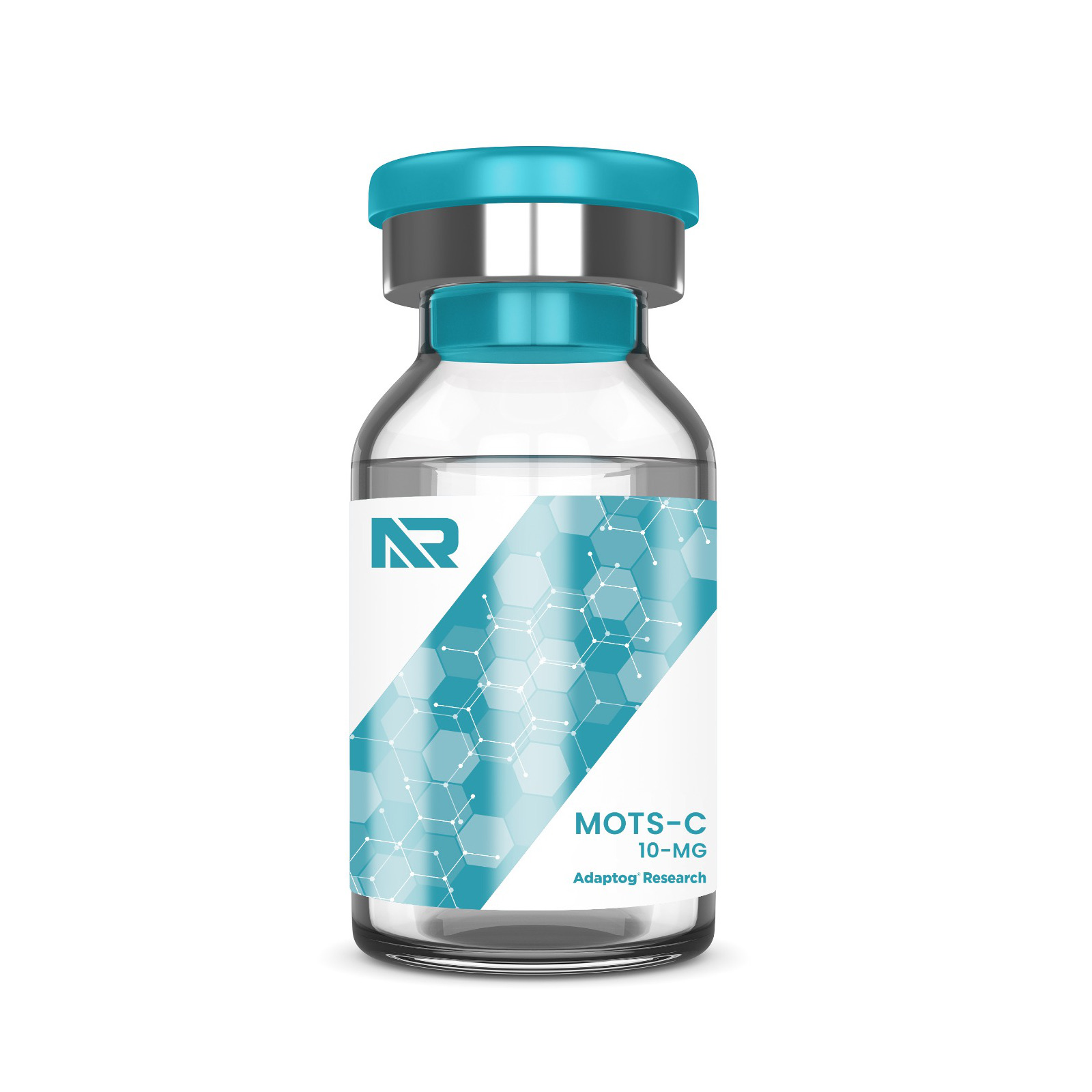

MOTS-c is a mitochondrial peptide associated with metabolism, stress response, and aspects of ageing and disease. It is a 16-amino acid peptide encoded by mitochondrial DNA, naturally found in tissues and blood. It was discovered in 2015 and has been the subject of various studies on metabolic health.
Mechanism of Action
While at rest, MOTS-c co-localises with mitochondria, but under metabolic or exercise stress, it migrates to the nucleus and alters gene expression, where it inhibits the folate cycle and de novo purine synthesis. This causes an accumulation of AICAR, an AMPK activator, and the subsequent activation of AMPK [1]. AMPK regulates cellular energy homeostasis and works by:
- Increasing glucose uptake and improving insulin sensitivity: This effect is most notable in skeletal muscle [2].
- Promoting fat burning, brown fat activation, and “browning” of white fat: This is linked to an increase in energy expenditure through thermogenesis, reduced fat mass, and improved glucose metabolism [3].
- Modulating inflammatory and antioxidant signalling: This happens through the activation of several cell survival, metabolic, and anti-inflammatory pathways [4].
Therapeutic Potential
MOTS-c is naturally present in human blood and tissues, and the effects of disease and exercise on endogenous levels have been investigated in human studies. It has also been investigated in preclinical tests, where it has been found to elicit several beneficial effects:
- Altered metabolism: It prevents diet- and age-related obesity and insulin resistance. It does this by improving glucose metabolism and adipose homeostasis [2]. It alleviates nonalcoholic fatty liver disease by improving mitochondrial metabolism and promoting cell survival [5]. A clinical study on an analogue of MOTS-c found that it produced statistically significant improvements in liver health, liver fat content, and body weight [6].
- Enhanced physical performance: It enhances glucose metabolism [7], reduces muscle atrophy [8], supports muscle differentiation [9], and improves exercise capacity [10] and age-related decline [11].
- Improved healthspan/lifespan: It maintains metabolic balance and improves physical capacity when given to aged mice [11].
- Cardioprotection: It protects against diabetic [12] and septic cardiomyopathy [13], as well as pressure overload heart failure [14]. This is due to its ability to activate antioxidant, anti-apoptotic, and AMPK-linked pathways.
- Anti-inflammation: It protects from acute lung injury by reducing inflammation, boosting glycolysis, and limiting ferroptosis [15].
- Improved pancreatic function: It modulates insulin and glucagon secretion and islet cell survival [16].
- Neuroprotection and pain: It reduces neuropathic pain via AMPK, microglia inhibition, and protection from neuronal oxidative damage [17].
- Cancer suppression: Experiments have found that MOTS-c can suppress certain types of cancer cell growth by acting through several signalling pathways [18].
MOTS-c is a mitochondrial signalling peptide that senses cellular stress and activates AMPK-centred pathways to maintain homeostasis. Most of our understanding of its activity is from observing natural levels and from animal and in vitro studies.
Safety
Because most of the research on MOTS-c is preclinical, there are few studies to confirm its safety. One clinical trial has tested the safety and efficacy of CB4211, a MOTS-c analogue, in the treatment of obese subjects with nonalcoholic fatty liver disease, where it was found to be effective at reducing body weight and liver fat content. In this study, mild to moderate injection site reactions were the only adverse events noted [6].
No in vitro toxicity has been observed, although it was found to inhibit the activity of certain neuronal cells at higher concentrations [19].
It is banned by the WADA, as it is an experimental peptide, is not approved for human use, and may have the potential to enhance performance.
How It Compares to Humanin
MOTS-c and humanin are both peptides encoded by mitochondrial DNA. Humanin was discovered in 2001, while MOTS-c is a more recent discovery. As such, we have more research elucidating Humanin’s mechanism of action and therapeutic potential in comparison to MOTS-c.
Their main similarities include:
- Origin: They are both from the 12S rRNA region of mitochondrial DNA.
- Systemic actions: They are both found in several tissues, as well as in circulation, where they modulate metabolism, oxidative stress, cell survival, and inflammation.
- Metabolic protection: They improve insulin sensitivity and protect against age-related metabolic disorders in animal models.
- Neuroprotection and cardioprotection: In models of Alzheimer’s disease and cardiovascular disease, they demonstrated protective effects.
- Responsiveness to exercise: Levels in the muscle increase in response to exercise [20].
Their differences include:
- Research focus: MOTS-c is more strongly established as a metabolic regulator of skeletal muscle, obesity, and insulin resistance. Humanin was originally linked to neuroprotection [21] and was later linked to beneficial activity in diabetes [22] and cardiovascular disease [23]. It is also linked to cancer-promoting activity and chemoresistance [24].
- Effects on mitochondria: Humanin directly improves mitochondrial biogenesis and function [25], while MOTS-c acts via cytosolic and nuclear signalling [1].
- Levels in exercise: Although they both decline with age, those who exercise are more likely to have higher humanin but lower MOTS-c than those who do not exercise [26].
Data Sheet
- Application: Research on metabolism, obesity, fatty liver disease, exercise performance, inflammation, neuroprotection, and cardiovascular disease.
- Pack Sizes: 10 mg
- CAS Number: 1627580-64-6
- Molecular Weight (g/mol): 2174.6
- Sequence: Met-Arg-Trp-Gln-Glu-Met-Gly-Tyr-Ile-Phe-Tyr-Pro-Arg-Lys-Leu-Arg
- Chemical Formula: C101H152N28O22S2
- Synonyms: MOTS-C, Mitochondrial Open Reading Frame of the 12S rRNA-c
- Storage: Keep refrigerated at 2-8°C until use. For long-term storage, keep at -20°C.
- Reconstitution: Reconstitute in sterile water. The reconstituted solution is stable for up to 30 days at 2-8°C.
- Organoleptic Profile: White to off-white lyophilised powder
- Physical Form: Solid
Conclusion
MOTS-c is a naturally occurring mitochondrial peptide that is currently being explored for its potential in several therapeutic areas due to its ability to alter metabolism and reduce inflammation through AMPK and similar pathways. Initial clinical studies on an analogue of this molecule have yielded promising results for its use in the treatment of fatty liver disease and obesity.
References
1. Kim KH, Son JM, Benayoun BA, Lee C. The Mitochondrial-Encoded Peptide MOTS-c Translocates to the Nucleus to Regulate Nuclear Gene Expression in Response to Metabolic Stress. Cell Metab. 2018;28(3):516-524.e7. doi:10.1016/j.cmet.2018.06.008
2. Lee C, Zeng J, Drew BG, et al. The Mitochondrial-Derived Peptide MOTS-c Promotes Metabolic Homeostasis and Reduces Obesity and Insulin Resistance. Cell Metab. 2015;21(3):443-454. doi:10.1016/j.cmet.2015.02.009
3. Lu H, Wei M, Zhai Y, et al. MOTS-c peptide regulates adipose homeostasis to prevent ovariectomy-induced metabolic dysfunction. J Mol Med. 2019;97(4):473-485. doi:10.1007/s00109-018-01738-w
4. Xinqiang Y, Quan C, Yuanyuan J, Hanmei X. Protective effect of MOTS-c on acute lung injury induced by lipopolysaccharide in mice. Int Immunopharmacol. 2020;80:106174. doi:10.1016/j.intimp.2019.106174
5. Lu H, Fan L, Zhang W, et al. The mitochondrial genome-encoded peptide MOTS-c interacts with Bcl-2 to alleviate nonalcoholic steatohepatitis progression. Cell Rep. 2024;43(1):113587. doi:10.1016/j.celrep.2023.113587
6. CohBar, Inc. A Phase 1a/1b Study of Safety, Tolerability, and Pharmacokinetics of CB4211 in Healthy Non-Obese Subjects and Subjects With Nonalcoholic Fatty Liver Disease. clinicaltrials.gov; 2021. Accessed February 6, 2026. https://clinicaltrials.gov/study/NCT03998514
7. Lee C, Kim KH, Cohen P. MOTS-c: A novel mitochondrial-derived peptide regulating muscle and fat metabolism. Free Radic Biol Med. 2016;100:182-187. doi:10.1016/j.freeradbiomed.2016.05.015
8. MOTS-c reduces myostatin and muscle atrophy signaling | American Journal of Physiology-Endocrinology and Metabolism | American Physiological Society. Am J Physiol-Endocrinol Metab. Accessed February 6, 2026. https://journals.physiology.org/doi/10.1152/ajpendo.00275.2020
9. García-Benlloch S, Revert-Ros F, Blesa JR, Alis R. MOTS-c promotes muscle differentiation in vitro. Peptides. 2022;155:170840. doi:10.1016/j.peptides.2022.170840
10. Yuan J, Wang M, Pan Y, et al. The mitochondrial signaling peptide MOTS-c improves myocardial performance during exercise training in rats. Sci Rep. 2021;11(1):20077. doi:10.1038/s41598-021-99568-3
11. Reynolds JC, Lai RW, Woodhead JST, et al. MOTS-c is an exercise-induced mitochondrial-encoded regulator of age-dependent physical decline and muscle homeostasis. Nat Commun. 2021;12(1):470. doi:10.1038/s41467-020-20790-0
12. Fu Y, Tang M, Duan Y, et al. MOTS-c regulates the ROS/TXNIP/NLRP3 pathway to alleviate diabetic cardiomyopathy. Biochem Biophys Res Commun. 2024;741:151072. doi:10.1016/j.bbrc.2024.151072
13. Wu J, Xiao D, Yu K, Shalamu K, He B, Zhang M. The protective effect of the mitochondrial-derived peptide MOTS-c on LPS-induced septic cardiomyopathy. Acta Biochim Biophys Sin. 2023;55(2):285-294. doi:10.3724/abbs.2023006
14. Zhong P, Peng J, Hu Y, Zhang J, Shen C. Mitochondrial derived peptide MOTS-c prevents the development of heart failure under pressure overload conditions in mice. J Cell Mol Med. 2022;26(21):5369-5378. doi:10.1111/jcmm.17551
15. Shen Z, Lu P, Jin W, et al. MOTS-c Promotes Glycolysis via AMPK–HIF-1α–PFKFB3 Pathway to Ameliorate Cardiopulmonary Bypass–induced Lung Injury. Am J Respir Cell Mol Biol. 2025;73(3):353-368. doi:10.1165/rcmb.2024-0533OC
16. Bień J, Pruszyńska-Oszmałek E, Kołodziejski P, Leciejewska N, Szczepankiewicz D, Sassek M. MOTS-c regulates pancreatic alpha and beta cell functions in vitro. Histochem Cell Biol. 2024;161(6):449-460. doi:10.1007/s00418-024-02274-0
17. Jiang J, Xu L, Yang L, Liu S, Wang Z. Mitochondrial-Derived Peptide MOTS-c Ameliorates Spared Nerve Injury-Induced Neuropathic Pain in Mice by Inhibiting Microglia Activation and Neuronal Oxidative Damage in the Spinal Cord via the AMPK Pathway. ACS Chem Neurosci. 2023;14(12):2362-2374. doi:10.1021/acschemneuro.3c00140
18. Yin Y, Li Y, Ma B, et al. Mitochondrial-Derived Peptide MOTS-c Suppresses Ovarian Cancer Progression by Attenuating USP7-Mediated LARS1 Deubiquitination. Adv Sci. 2024;11(43):e2405620. doi:10.1002/advs.202405620
19. Lin Y, Yang R yu, Li J, et al. MOTS-c-modified functional self-assembly peptide hydrogels enhance the activity of nucleus pulposus-derived mesenchymal stem cells of intervertebral disc degeneration. Mater Today Bio. 2025;32:101872. doi:10.1016/j.mtbio.2025.101872
20. Merry TL, Chan A, Woodhead JST, et al. Mitochondrial-derived peptides in energy metabolism. Am J Physiol-Endocrinol Metab. 2020;319(4):E659-E666. doi:10.1152/ajpendo.00249.2020
21. Hashimoto Y, Niikura T, Tajima H, et al. A rescue factor abolishing neuronal cell death by a wide spectrum of familial Alzheimer’s disease genes and Abeta. Proc Natl Acad Sci U S A. 2001;98(11):6336-6341. doi:10.1073/pnas.101133498
22. Mahboobi H, Golmirzaei J, Gan SH, Jalalian M, Kamal MA. Humanin: a possible linkage between Alzheimer’s disease and type 2 diabetes. CNS Neurol Disord Drug Targets. 2014;13(3):543-552. doi:10.2174/1871527312666131223110147
23. Rochette L, Meloux A, Zeller M, Cottin Y, Vergely C. Role of humanin, a mitochondrial-derived peptide, in cardiovascular disorders. Arch Cardiovasc Dis. 2020;113(8):564-571. doi:10.1016/j.acvd.2020.03.020
24. Moreno Ayala MA, Gottardo MF, Zuccato CF, et al. Humanin Promotes Tumor Progression in Experimental Triple Negative Breast Cancer. Sci Rep. 2020;10(1):8542. doi:10.1038/s41598-020-65381-7
25. Qin Q, Jin J, He F, et al. Humanin promotes mitochondrial biogenesis in pancreatic MIN6 β-cells. Biochem Biophys Res Commun. 2018;497(1):292-297. doi:10.1016/j.bbrc.2018.02.071
26. Alser M, Ramanjaneya M, Rizwana Anwardeen N, et al. The Effect of Chronic Endurance Exercise on Serum Levels of MOTS-c and Humanin in Professional Athletes. Rev Cardiovasc Med. 2022;23(5):181. doi:10.31083/j.rcm2305181

Reviews
There are no reviews yet.