
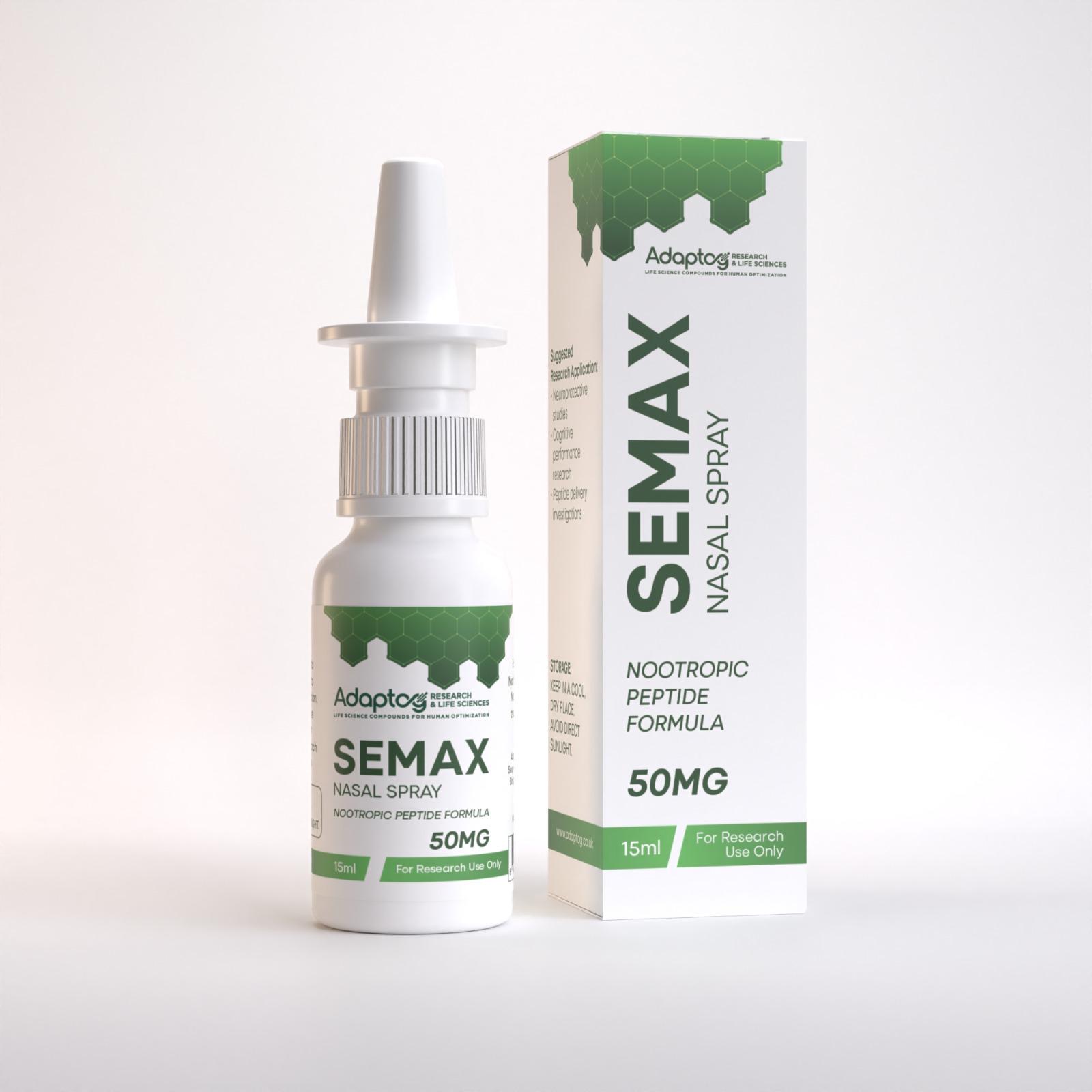

Semax is a synthetic heptapeptide that contains amino acids 4-7 from the hormone ACTH and an additional Pro-Gly-Pro sequence at the C-terminal to enhance stability. Although it is derived from ACTH, which promotes the release of cortisol, Semax does not have the same downstream hormonal effects. It is primarily known for its beneficial effects on the brain.
Mechanism of action
It acts as a nootropic, neurotrophic, and neuroprotective agent by:
- Increasing BDNF protein: The synthesis of BDNF is increased in the forebrain of rats. Here, it is able to modulate synaptic plasticity.1
- Suppressing the expression of inflammatory genes: It can significantly reduce the expression of the pro-inflammatory cytokines Il1a, Il1b, Il6, Ccl3, and Cxcl2.2
- Modulates the expression of immune-related genes: The expression of both chemokines and immunoglobulins was altered within hours of Semax administration.3
- Prevents decline in the expression of genes related to neurotransmission: Genes involved in neurotransmission are activated soon after administration.4
- Potentiates dopamine and serotonergic transmission: It modulates the serotonergic system and increases the release of dopamine in rodents.5
- Promotes the survival of neurons under stress: Neurons challenged by oxidative stress are less likely to suffer damage when treated with Semax.6
Therapeutic potential
This broad range of effects that Semax confers to the brain means that it has the potential to improve brain health, recovery, and cognition. It has been investigated in the following areas:
- Therapy for ischemic stroke: In animal models, it can improve functional and motor recovery, as well as improve cognitive deficits caused by cerebral ischemia.7,8 This is thought to be due to its ability to enhance cell survival and reduce inflammation.
- Cognitive impairment and dementia: Semax helps to prevent the formation of Aβ:Cu2+ complexes and can prevent aggregates from forming in vitro.9 Animal experiments have found that it can enhance memory and attention.10
- Anxiety and depression: Animal tests have suggested that chronic administration of Semax may reduce anxiety and depression.10,11
- Spinal cord injury: It improved functional recovery and reduced oxidative stress in animal models of spinal cord injury.12
Semax has demonstrated a wide range of beneficial effects on the brain, most of which have been investigated in vitro and with the help of animal models.
Safety
Semax has been tested on humans in doses of up to 18 mg per day in addition to conventional stroke therapy, where it has been beneficial to recovery.13,14 It has also been administered in doses of 12 mg per day, intranasally, for a total of 20 days to patients suffering from motor neuron disease, where it improved quality of life15 and has been used to improve optic nerve disease.16
Most clinical studies have been short but have revealed no adverse reactions, low toxicity, and high tolerability.
High doses of alcohol in rats were found to increase the intensity of cravings for alcohol, and the administration of Semax did not mitigate this.17
How it compares to Selank
Both Semax and Selank are synthetic neuropeptides, but they differ in the following ways:
- Origin: Semax is derived from the ACTH hormone. Although ACTH signals to the adrenal glands to produce cortisol, a hormone that regulates the body’s response to stress, Semax does not trigger this same hormonal response. Selank is an extended version of an immunomodulatory peptide called tuftsin.
- Mechanism: Semax works mainly through the stimulation of BDNF, immunomodulatory activity, cell survival, and the potentiation of dopamine and serotonin. Selank works by modulating GABAergic pathways, influencing monoamine neurotransmitters, and increasing BDNF.
- Research focus: Research on Semax has focused mainly on its ability to mitigate neuronal damage and increase cognition. Selank has been studied for its anxiolytic effect.
Data sheet
| Application | Research on neurotrophy, neuroprotection, and cognitive enhancement |
| CAS Number | 80714-61-0 |
| Molecular Weight (g/mol) | 813.92 |
| Sequence | Met-Glu-His-Phe-Pro-Gly-Pro |
| Chemical Formula | C37H51N9O10S |
| Synonyms | ACTH(4–7) Pro-Gly-Pro, MEHFPGP |
| Storage | Keep refrigerated at 2–8°C until use. For long-term storage, keep at -20°C. |
| Form | Nasal Spray |
Conclusion
Semax has been found to exert several beneficial effects on the brain, mitigating damage and improving cognition. So far, animal and human studies have found that it produces statistically significant improvements with high tolerability.
References
- Dolotov OV, Karpenko EA, Seredenina TS, et al. Semax, an analogue of adrenocorticotropin (4-10), binds specifically and increases levels of brain-derived neurotrophic factor protein in rat basal forebrain. J Neurochem. 2006;97 Suppl 1:82-86. doi:10.1111/j.1471-4159.2006.03658.x
- Dergunova LV, Dmitrieva VG, Filippenkov IB, et al. [The Peptide Drug ACTH(4-7)PGP (Semax) Suppresses mRNA Transcripts Encoding Proinflammatory Mediators Induced by Reversible Ischemia of the Rat Brain]. Mol Biol (Mosk). 2021;55(3):402-411. doi:10.31857/S0026898421010043
- Medvedeva EV, Dmitrieva VG, Povarova OV, et al. The peptide semax affects the expression of genes related to the immune and vascular systems in rat brain focal ischemia: genome-wide transcriptional analysis. BMC Genomics. 2014;15:228. doi:10.1186/1471-2164-15-228
- Filippenkov IB, Stavchansky VV, Denisova AE, et al. Novel Insights into the Protective Properties of ACTH(4-7)PGP (Semax) Peptide at the Transcriptome Level Following Cerebral Ischaemia–Reperfusion in Rats. Genes. 2020;11(6):681. doi:10.3390/genes11060681
- Eremin KO, Kudrin VS, Saransaari P, et al. Semax, an ACTH(4-10) analogue with nootropic properties, activates dopaminergic and serotoninergic brain systems in rodents. Neurochem Res. 2005;30(12):1493-1500. doi:10.1007/s11064-005-8826-8
- Safarova ER, Shram SI, Zolotarev YA, Myasoedov NF. Effect of Semax peptide on survival of cultured rat pheochromocytoma cells during oxidative stress. Bull Exp Biol Med. 2003;135(3):268-271. doi:10.1023/a:1024141232307
- Iasnetsov VV, Krylova IN, Provornova NA. [Pharmacological treatment of memory disorders caused by hypoxia and cerebral ischemia in rats]. Aviakosmicheskaia Ekol Meditsina Aerosp Environ Med. 1998;32(1):55-60.
- Sudarkina OY, Filippenkov IB, Stavchansky VV, et al. Brain Protein Expression Profile Confirms the Protective Effect of the ACTH(4-7)PGP Peptide (Semax) in a Rat Model of Cerebral Ischemia-Reperfusion. Int J Mol Sci. 2021;22(12):6179. doi:10.3390/ijms22126179
- Sciacca MFM, Naletova I, Giuffrida ML, Attanasio F. Semax, a Synthetic Regulatory Peptide, Affects Copper-Induced Abeta Aggregation and Amyloid Formation in Artificial Membrane Models. ACS Chem Neurosci. 2022;13(4):486-496. doi:10.1021/acschemneuro.1c00707
- Levitskaya N, Glazova N, Sebentsova E, et al. Investigation of the spectrum of physiological activities of the heptapeptide Semax, an ACTH(4-10) analogue. Neurochem J. 2008;2:95-101. doi:10.1134/S1819712408010182
- Glazova NY, Manchenko DM, Volodina MA, et al. Semax, synthetic ACTH(4-10) analogue, attenuates behavioural and neurochemical alterations following early-life fluvoxamine exposure in white rats. Neuropeptides. 2021;86:102114. doi:10.1016/j.npep.2020.102114
- Liu R, Chen Y, Huang H, et al. Semax peptide targets the μ opioid receptor gene Oprm1 to promote deubiquitination and functional recovery after spinal cord injury in female mice. Br J Pharmacol. 2025;182(22):5489-5516. doi:10.1111/bph.70122
- Gusev EI, Skvortsova VI, Miasoedov NF, Nezavibat’ko VN, Zhuravleva EI, Vanichkin AV. [Effectiveness of semax in acute period of hemispheric ischemic stroke (a clinical and electrophysiological study)]. Zh Nevrol Psikhiatr Im S S Korsakova. 1997;97(6):26-34.
- Gusev EI, Martynov MY, Kostenko EV, Petrova LV, Bobyreva SN. [The efficacy of semax in the tretament of patients at different stages of ischemic stroke]. Zh Nevrol Psikhiatr Im S S Korsakova. 2018;118(3. Vyp. 2):61-68. doi:10.17116/jnevro20181183261-68
- Serdiuk AV, Levitskiĭ GN, Miasoedov NF, Skvortsova VI. [The study of chronic partial denervation and quality of life in patients with motor neuron disease treated with semax]. Zh Nevrol Psikhiatr Im S S Korsakova. 2007;107(4):29-39.
- Polunin GS, Nurieva SM, Baiandin DL, Sheremet NL, Andreeva LA. [Evaluation of therapeutic effect of new Russian drug semax in optic nerve disease]. Vestn Oftalmol. 2000;116(1):15-18.
- The influence of the semax nootropic agent on the… : Neurochemical Journal. Ovid. doi:10.1007/s11710-008-1009-1
Reviews
There are no reviews yet.