
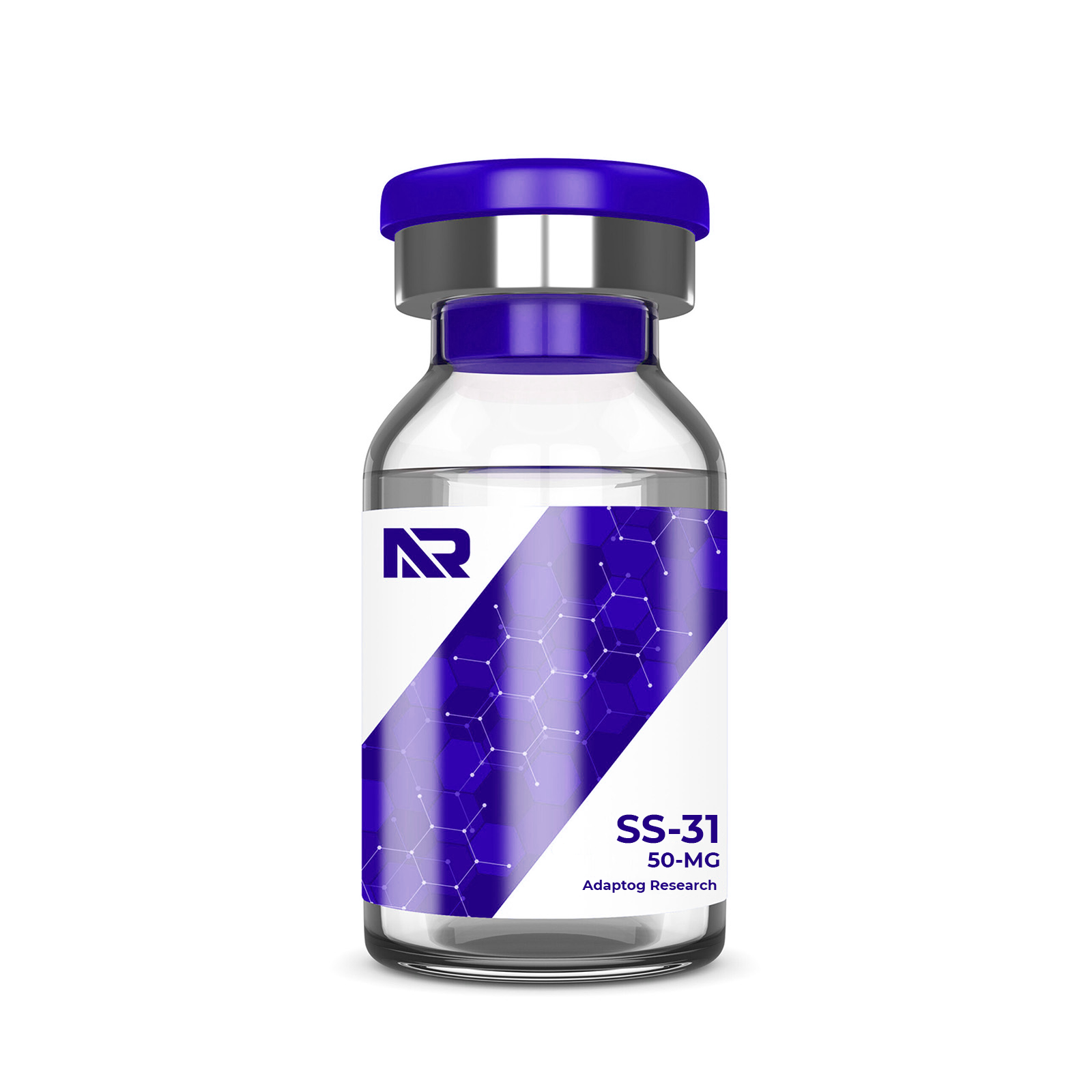
SS-31, also known as elamipretide, is a synthetic tetrapeptide with the sequence D-Arg-Dmt-Lys-Phe-NH₂, originally developed by Szeto and Schiller. It is selectively taken up by mitochondria, where it accumulates in the inner mitochondrial membrane and exerts protective activity.
Because of its beneficial effect on mitochondrial function, it has received accelerated approval by the FDA for the treatment of Barth syndrome, a genetic disease that affects the formation of cardiolipin, leading to muscle weakness, neutropenia, and delayed growth. Its ability to benefit mitochondrial function means that it could be useful in the treatment of other conditions involving mitochondrial damage and dysfunction.
Mechanism of Action
SS-31 preserves mitochondrial function by concentrating in the mitochondria,1 where it binds to cardiolipin (CL). CL is a phospholipid found only in the inner mitochondrial membrane and is responsible for organising respiratory supercomplexes and cristae architecture. When SS-31 binds to CL, it:
- Prevents CL from undergoing peroxidation: Normally, CL anchors cytochrome c (cyt c) to the inner mitochondrial membrane. Peroxidation of CL frees cyt c into the intermembrane space, where it may then be released into the cytosol, triggering a caspase cascade that results in cell death. SS-31 binds to CL, stabilising it and preventing peroxidation2.
- Stops CL from converting cyt c into a peroxidase: Cyt c acts as an electron carrier, moving electrons from Complex III to Complex IV. CL acts as a platform between these complexes for cyt c to bind to so that it can transfer electrons between them. Under conditions of stress, cyt c is converted to a peroxidase, which no longer transports electrons. SS-31 prevents peroxidation of cyt c’s heme iron when it binds to CL, preventing changes in the interaction between CL and cyt c that would lead to oxidative stress. It does this without disrupting electron transport.3
Therapeutic Potential
Because of its ability to protect CL and preserve mitochondrial function under conditions of stress, SS-31 may be of use in the treatment of diseases related to mitochondrial damage. Researchers have investigated its potential use for the treatment of:
- Heart failure: It improved the respiration of mitochondria in the heart tissue of heart failure patients.4 In a cardiovascular disease model, SS-31 reduced cardiotoxicity by acting as a ROS scavenger and inhibiting the p38 MAPK signalling pathway.5 It was also tested in a diabetic model, where it improved the symptoms of cardiomyopathy and rectified mitochondrial dysfunction.6
- Kidney disease: In animal models of kidney disease, it reduced oxidative stress, fibrosis, inflammation, and apoptosis, significantly improving the survival of animals.7,8
- Alzheimer’s disease: In an animal model of Alzheimer’s disease, SS-31 was found to cross the blood-brain barrier, reduce Aβ levels, restore mitochondrial function, and promote mitochondrial biogenesis.9
- Pulmonary fibrosis: In animal models where damage was induced by bleomycin, SS-31 reduced inflammation and protected against fibrosis.10
- Barth syndrome/primary mitochondrial myopathy: SS-31 has been tested on patients with Barth syndrome, where it improved muscle strength, improved cardiac parameters, and the quality of life of patients.11,12
Due to its ability to protect CL and preserve mitochondrial function, SS-31 can reduce oxidative stress in the mitochondria, thus reducing inflammation and cell damage. Since inflammation is a common component in the pathology of many diseases, this gives it broad medicinal potential.
Safety
SS-31 is well tolerated and considered to have low toxicity. In clinical trials, no serious adverse events have been reported. Injection site reactions have been experienced by some participants. Due to limited research, the long-term safety of this peptide is unknown.
How SS-31 Compares to MOTS-c
Both SS-31 and MOTS-c are peptides that benefit mitochondrial function. MOTS-c is a naturally occurring mitochondrial peptide that works through different mechanisms to achieve different outcomes than SS-31.
SS-31 protects CL and cyt c from peroxidation, which would normally happen under conditions of stress, while MOTS-c works by inhibiting the folate cycle and de novo purine synthesis, which leads to regulation of energy homeostasis.
MOTS-c is able to:
- Increase glucose uptake
- Improve insulin sensitivity
- Promote thermogenesis
- Promote cell survival
- Activate anti-inflammatory pathways
The net effect is a promotion of fat loss, improvement in pancreatic function and physical performance, and a reduction in damage and pain caused by inflammation.
Both SS-31 and MOTS-c have low toxicity and few adverse effects.
Data Sheet
- Application: Research on mitochondrial function, mitochondrial stress signalling, and diseases related to mitochondrial dysfunction.
- Pack Size: 50 mg
- CAS Number: 736992-21-5
- Molecular Weight (g/mol): 639.8
- Sequence: H-D-Arg-Tyr(2,6-diMe)-Lys-Phe-NH2
- Chemical Formula: C32H49N9O5
- Synonyms: Elamipretide, bendavia, MTP-131
- Storage: Keep refrigerated at 2-8°C until use. For long-term storage, keep at -20°C.
- Reconstitution: Reconstitute in sterile water. The reconstituted solution is stable for up to 30 days at 2-8°C
- Organoleptic Profile: White to off-white lyophilised powder
- Physical Form: Solid
Conclusion
SS-31 is a highly specific and effective peptide that protects both CL and cyt c, preventing the cell death that would result from their peroxidation. It allows the mitochondria to continue to function and maintain their integrity, even when placed under stress. Since mitochondria can be stressed by various conditions and diseases, SS-31 has broad medicinal potential for which more research is warranted.
References
- Zhao K, Luo G, Giannelli S, Szeto HH. Mitochondria-targeted peptide prevents mitochondrial depolarization and apoptosis induced by tert-butyl hydroperoxide in neuronal cell lines. Biochem Pharmacol. 2005;70(12):1796-1806. doi:10.1016/j.bcp.2005.08.022
- Birk AV, Liu S, Soong Y, et al. The Mitochondrial-Targeted Compound SS-31 Re-Energizes Ischemic Mitochondria by Interacting with Cardiolipin. J Am Soc Nephrol. 2013;24(8):1250-1261. doi:10.1681/ASN.2012121216
- Birk AV, Chao WM, Bracken C, Warren JD, Szeto HH. Targeting mitochondrial cardiolipin and the cytochrome c/cardiolipin complex to promote electron transport and optimize mitochondrial ATP synthesis. Br J Pharmacol. 2014;171(8):2017-2028. doi:10.1111/bph.12468
- Yuan S, Che Y, Wang Z, Xing K, Xie X, Chen Y. Mitochondrion-targeted carboxymethyl chitosan hybrid nanoparticles loaded with Coenzyme Q10 protect cardiac grafts against cold ischaemia‒reperfusion injury in heart transplantation. J Transl Med. 2023;21(1):925. doi:10.1186/s12967-023-04763-7
- Zhang L, Feng M, Wang X, et al. Peptide Szeto‑Schiller 31 ameliorates doxorubicin‑induced cardiotoxicity by inhibiting the activation of the p38 MAPK signaling pathway. Int J Mol Med. 2021;47(4):63. doi:10.3892/ijmm.2021.4896
- Xiong L, Hu H, Zhu F, et al. New insight for SS-31 in treating diabetic cardiomyopathy: Activation of mitoGPX4 and alleviation of mitochondria-dependent ferroptosis. Int J Mol Med. 2024;54(6):112. doi:10.3892/ijmm.2024.5436
- Lin Z, Zhou E, Zhang D, et al. HA/CD44–SS31 Mitochondrial Targeting of Manganese Oxide Nanozymes for Ischemia-Reperfusion-Induced Acute Kidney Injury Therapy. ACS Nano. 2026;20(6):4866-4890. doi:10.1021/acsnano.5c16933
- Liu D, Shu G, Jin F, et al. ROS-responsive chitosan-SS31 prodrug for AKI therapy via rapid distribution in the kidney and long-term retention in the renal tubule. Sci Adv. 2020;6(41):eabb7422. doi:10.1126/sciadv.abb7422
- Reddy PH, Manczak M, Kandimalla R. Mitochondria-targeted small molecule SS31: a potential candidate for the treatment of Alzheimer’s disease. Human Molecular Genetics. 2017;26(8):1483-1496. doi:10.1093/hmg/ddx052
- Nie Y, Li J, Zhai X, et al. Elamipretide(SS-31) Attenuates Idiopathic Pulmonary Fibrosis by Inhibiting the Nrf2-Dependent NLRP3 Inflammasome in Macrophages. Antioxidants (Basel). 2023;12(12):2022. doi:10.3390/antiox12122022
- Reid Thompson W, Hornby B, Manuel R, et al. A phase 2/3 randomized clinical trial followed by an open-label extension to evaluate the effectiveness of elamipretide in Barth syndrome, a genetic disorder of mitochondrial cardiolipin metabolism. Genet Med. 2021;23(3):471-478. doi:10.1038/s41436-020-01006-8
- Thompson WR, Manuel R, Abbruscato A, et al. Long-term efficacy and safety of elamipretide in patients with Barth syndrome: 168-week open-label extension results of TAZPOWER. Genet Med. 2024;26(7):101138. doi:10.1016/j.gim.2024.101138

Reviews
There are no reviews yet.