Disclaimer: The following product is intended solely for research purposes. We do not promote or encourage any consumption outside of authorised trials.
GHK is a tripeptide made by the body and is composed of the amino acids glycine, histidine, and lysine. It binds to copper(II) ions, which enhances its biological activity.
GHK is known for its ability to promote wound healing, tissue regeneration, and collagen synthesis and has anti-inflammatory and antioxidant activity.
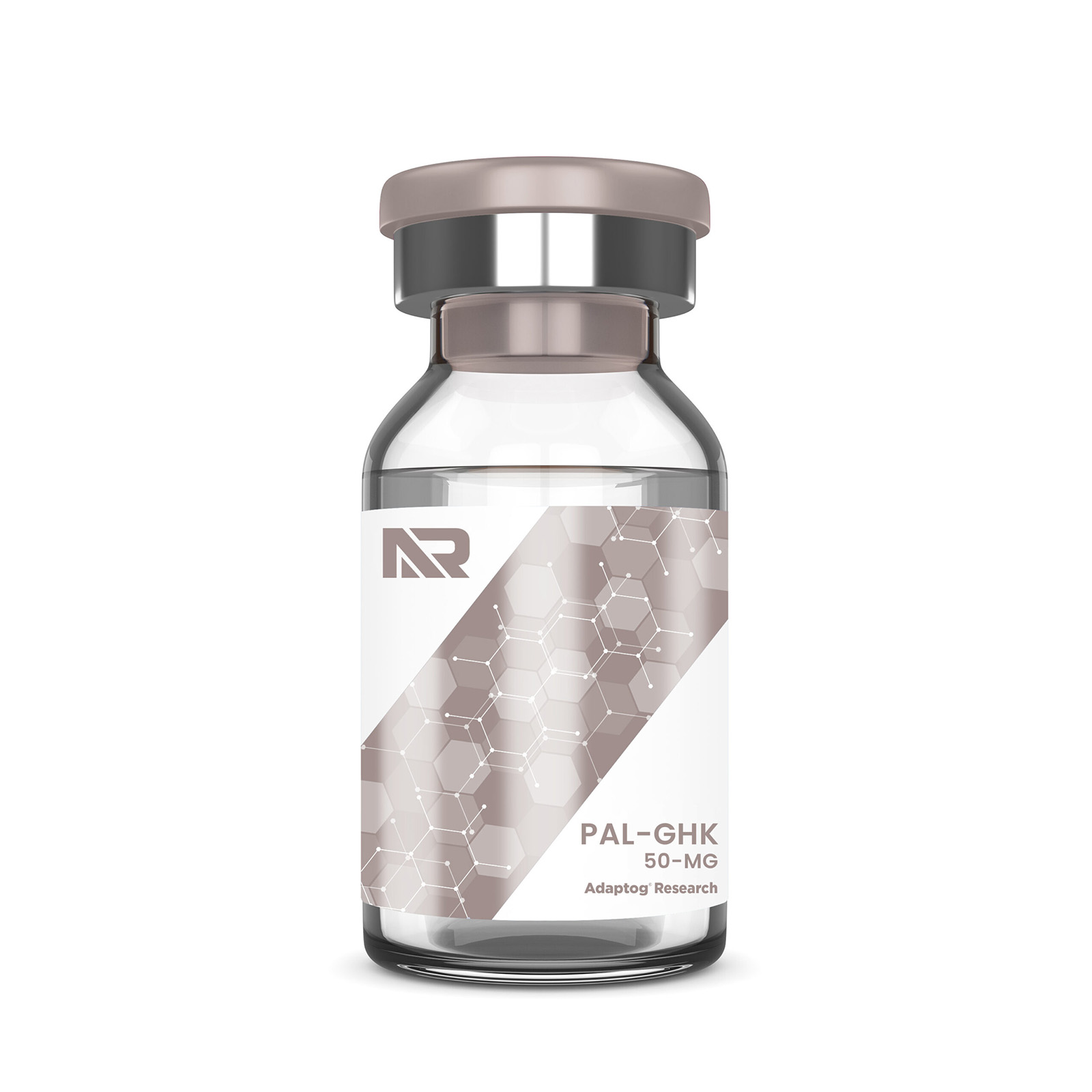
Pal-GHK is a modified version of the GHK peptide and is made by reacting GHK with palmitic acid. This palmitoyl tripeptide has improved absorption through the skin, making it particularly effective for topical use.
Mechanism of Action
Pal-GHK exerts its activity by:
- Stimulating the synthesis of the extracellular matrix (ECM): This includes collagen, glycosaminoglycans, and other components essential for skin structure [1].
- Modulating the activity of matrix metalloproteases and their inhibitors: This modulates the breakdown and remodelling of skin components during healing [2].
- Promoting the recruitment of immune and endothelial cells to sites of injury: This supports angiogenesis and tissue repair [3].
- Reducing inflammation and promoting fibroblast proliferation: This may be owed partly to its ability to act as an antioxidant and reduce ROS4 and help accelerate wound healing and tissue regeneration [3].
Promoting angiogenesis: The growth of new blood vessels is stimulated, which increases the supply of nutrients and growth factors to tissues [5].
Improving skin permeability: The palmitoyl group of this peptide increases permeability, allowing it to penetrate deeper into the skin and to exert its activity at lower concentrations [6].
Therapeutic Potential
These mechanisms make Pal-GHK a useful peptide for wound healing and cosmetic applications. It has been investigated for its use in:
- Skin regeneration and anti-aging: All of the above-mentioned mechanisms work together to improve the health and appearance of skin by promoting collagen synthesis, increasing skin thickness and elasticity, enhancing dermal hydration, and reducing wrinkles. The palmitoyl group enables the peptide to penetrate much further into the skin compared to the unmodified peptide, allowing these benefits to reach the deeper layers of the skin.
- Wound healing: The ability of Pal-GHK to reduce inflammation, promote angiogenesis, and stimulate the regeneration of tissues enables it to accelerate the rate at which wounds heal [7,8].
Safety
Pal-GHK has been tested in clinical studies where it was found to be safe, with no adverse events being reported [9]. In one study, where it was tested as part of a lip treatment, some participants reported mild burning and tingling [10]. It is approved for use as a cosmetic ingredient.
How It Compares To GHK-Cu
Pal-GHK is notable for its ability to penetrate the skin with greater efficacy than GHK and GHK-Cu. This enhanced penetration allows it to reach deeper tissues, requiring a lower dose to exert its benefits [6].
Copper ions enhance the potency of this tripeptide, making GHK-Cu more bioactive than Pal-GHK [11].
Overall, both Pal-GHK and GHK-Cu are associated with similar biological activities. The main differences between them are their potency and skin penetration, with GHK-Cu being considered more active and Pal-GHK being better able to deeply penetrate the skin. This makes Pal-GHK ideal for cosmetic purposes where topical application is preferred.
Data Sheet
- Application: Cosmetic, anti-aging, and wound healing
- CAS Number: 147732-56-7
- Molecular Weight: 578.8
- Sequence: Pal-Gly-His-Lys
- Chemical Formula: C₃₀H₅₄N₆O₅
- Synonyms: C16-GHK, C16-GK-3, palmitoyl oligopeptide, palmitoyl tripeptide-1, palmitoyl glycyl-l-histidyl-l-lysine
- Storage: Keep refrigerated at 2-8°C until use. For long-term storage, keep at -20°C.
- Reconstitution: Reconstitute in sterile water. The reconstituted solution is stable for up to 30 days at 2-8°C.
- Organoleptic Profile: White to off-white lyophilised powder
- Physical Form: Solid
Conclusion
Pal-GHK is a bioactive tripeptide that can promote tissue regeneration and remodelling, reduce inflammation, and increase skin permeability. Because of its exceptional ability to deeply penetrate tissues, it is used in cosmetic applications, where it can be applied to the skin to promote skin regeneration and reduce wrinkles. It can also be used in medical applications to accelerate the rate at which wounds heal.
References
- Maquart FX, Siméon A, Pasco S, Monboisse JC. [Regulation of cell activity by the extracellular matrix: the concept of matrikines]. J Soc Biol. 1999;193(4-5):423-428.
- Pickart L. The use of glycylhistidyllysine in culture systems. In Vitro. 1981;17(6):459-466. doi:10.1007/BF02633506
- Pickart L, Vasquez-Soltero JM, Margolina A. GHK Peptide as a Natural Modulator of Multiple Cellular Pathways in Skin Regeneration. BioMed Res Int. 2015;2015:648108. doi:10.1155/2015/648108
- Sakuma S, Ishimura M, Yuba Y, Itoh Y, Fujimoto Y. The peptide glycyl-ʟ-histidyl-ʟ-lysine is an endogenous antioxidant in living organisms, possibly by diminishing hydroxyl and peroxyl radicals. Int J Physiol Pathophysiol Pharmacol. 2018;10(3):132-138.
- Jose S, Hughbanks ML, Binder BYK, Ingavle GC, Leach JK. Enhanced trophic factor secretion by mesenchymal stem/stromal cells with Glycine-Histidine-Lysine (GHK)-modified alginate hydrogels. Acta Biomater. 2014;10(5):1955-1964. doi:10.1016/j.actbio.2014.01.020
- Park SI, An GM, Kim MG, Heo SH, Shin MS. Enhancement of Skin Permeation of Wrinkle Improvement Peptides GHKs Using Liposomes Containing Skin Penetrating Peptides. J Korean Appl Sci Technol. 2019;36(3):853-865.
- Pickart L, Vasquez-Soltero JM, Margolina A. GHK Peptide as a Natural Modulator of Multiple Cellular Pathways in Skin Regeneration. BioMed Res Int. 2015;2015:648108. doi:10.1155/2015/648108
- [28] Biological activity of human plasma copper-binding growth factor glycyl-l-histidyl-l-lysine. In: Methods in Enzymology. Vol 147. Academic Press; 1987:314-328. doi:10.1016/0076-6879(87)47121-8
- A Clinical Study on Anti-wrinkle Efficacy of a Cosmetics Containing Oligoarginine Conjugation of Palmitoyl-GHK peptide for Skin Penetrating. ResearchGate. Published online August 9, 2025. doi:10.17762/turcomat.v12i5.974
- Trookman NS, Rizer RL, Ford R, Mehta R, Gotz V. Clinical Assessment of a Combination Lip Treatment to Restore Moisturization and Fullness. J Clin Aesthetic Dermatol. 2009;2(12):44-48.
- Pickart L, Margolina A. Regenerative and Protective Actions of the GHK-Cu Peptide in the Light of the New Gene Data. Int J Mol Sci. 2018;19(7):1987. doi:10.3390/ijms19071987