HGH (human growth hormone) is a hormone produced by the pituitary gland that drives growth and development, regulates metabolism, and thus influences body composition. Several fragments can be derived from this hormone, which exerts activities that differ from those of the full-length hormone.
The most extensively explored fragment is fragment 176-191, which has been investigated as a potential weight loss drug. It is sometimes referred to as AOD9604, but these two compounds are subtly different. This article will attempt to explain what fragment 176-191 is in relation to AOD9604 and another similar peptide, AOD9401. It will also explore the limitations of the data available on these peptides.
HGH Mechanism
Before examining the peptides, we should understand the hormone from which they are derived. HGH binds to growth hormone receptors on cells, triggering signalling pathways that control growth and metabolism. The growth-promoting activity of HGH is mediated by IGF-1, which:
- Promotes muscle protein synthesis
- Inhibits protein breakdown
- Promotes bone development
- Increases bone density
- Promotes glucose uptake
HGH is also lipolytic and:
- Stimulates the oxidation of fat, especially during periods of fasting
- Promotes insulin resistance
The net outcome of HGH administration when it is used for the treatment of GH deficiency is enhanced growth with a notable drawback of insulin resistance.
Although the half-life of HGH is only about 20 minutes1, the signalling it triggers can produce effects that last for hours afterward. Additionally, when HGH is broken down, biologically active fragments are produced, which can exert similar effects to HGH.
How Fragments are Made by the Body
HGH is a single-chain polypeptide that is 191 amino acids long. This chain can be broken down by enzymes in the body to produce shorter fragments. Some of these fragments bear some similarity to the activity of the parent hormone, some offer new benefits, while others have unknown activity2,3.
The different fragments are given names that reflect the amino acid residues they retain from the full-length hormone. For example, fragment 1-43 is made up of only amino acids 1 to 43 of HGH, while fragment 176-191 is made up of the last 16 amino acids of the polypeptide chain.
Fragment 176-191
HGH fragment 176-191 is the most studied of all the fragments. It is produced endogenously, but can also be synthesised using a technique called solid phase peptide synthesis.
This fragment has been found to exert the following activities:
- Lipolytic activity: This fragment appears to be the portion of HGH that is responsible for altering fat metabolism. When given to mice, it causes a reduction in weight gain and stimulates lipolytic activity4. It does this by increasing energy expenditure and fat oxidation, resulting in a reduction in adiposity and reduced weight gain5.
- Suppression of lipogenesis: It can prevent fatty acids from being stored as triglycerides in fat cells3.
From reading the papers cited, you will find that these studies did not use native fragment 176-191. The reason these activities are mentioned under the heading of fragment 176-191 will become clearer further on.
Fragment 176-191 vs HGH
Although both HGH and fragment 176-191 both possess lipolytic activity, the fragment is more favourable over the full length hormone for the purposes of enhancing lipolytic activity. It exerts this activity without promoting growth and development, and this narrower biological activity makes it useful for more targeted treatments.
HGH treatment is associated with a decrease in sensitivity to insulin despite the insulin like effect of IGF-1, which is promoted by HGH. As a result, the body is less able to take up glucose from the blood. This leads to higher blood sugar levels, which can stimulate the pancreas to release even more insulin. This effect means that those taking HGH as part of a treatment are at increased risk of developing insulin resistance or type 2 diabetes. Fragment 176-191 does not have any adverse effect on insulin sensitivity in some studies on animal models or in humans4,6.
From this brief comparison, we can see that HGH offers broad benefits that are useful for the treatment of growth hormone deficiency, although the risk of developing insulin resistance increases. Fragment 176-191, having a much narrower range of activity, offers only the lipolytic activity of the hormone.
There are several peptides that borrow the lipolytic C terminal sequence from HGH. Fragment 176-191 is the most popularly known, followed by AOD9604 and AOD9401. We will look at the structure of these three peptides in greater detail.
Structures
Fragment 176-191
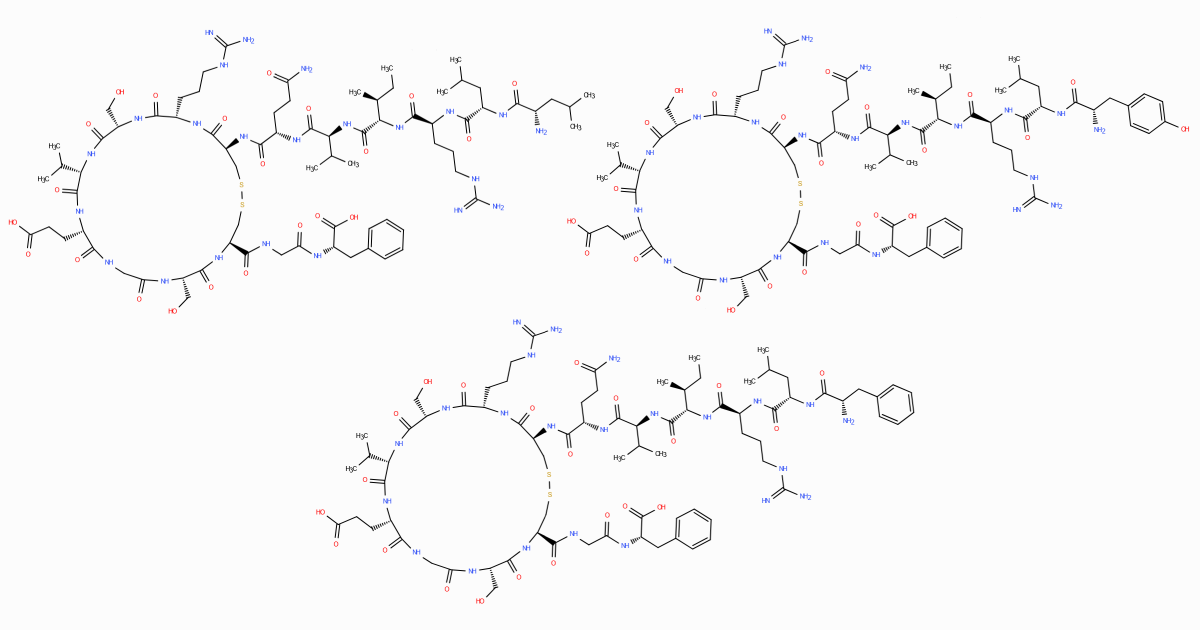
Structurally, this fragment consists of amino acids in the sequence Phe-Leu-Arg-Ile-Val-Gln-Cys-Arg-Ser-Val-Glu-Gly-Ser-Cys-Gly-Phe, with a disulphide bridge between the cysteine residues. It is vulnerable to damage from exposure to heat, moisture and light. These quickly degrade the peptide, reducing its activity. Repeated freeze-thaw cycles or simply shaking a solution of the peptide can cause it to denature. This poses problems for researchers as the fragment can degrade so rapidly that results from experiments become difficult to reproduce and are less reliable.
An analogue of fragment 176-191, AOD9604, was synthesised, which is often reported to have greater stability.
AOD9604
AOD9604 is said to be a more stable version of fragment 176-191. The N terminal phenylalanine is replaced with a tyrosine, giving it a sequence of Tyr-Leu-Arg-Ile-Val-Gln-Cys-Arg-Ser-Val-Glu-Gly-Ser-Cys-Gly-Phe. Again, this peptide is cyclic as it has the same disulphide bridge between the two cysteine residues. The tyrosine is anecdotally reported to enhance its stability and half-life; however, it is also sensitive to the same elements as fragment 176-191 and can easily aggregate after being dissolved into solution.
AOD9401
AOD9401 is another cyclic, synthetic peptide comprising residues 177-191 and which also has lipolytic activity7. As we can see from the research on these fragments so far, the 176th residue does not appear to be essential for lipolytic activity.
Half-Life and Duration of Effects
There is very little research on the half-life of these compounds. Despite the fact that AOD9604 is said to be more stable, we have very little data to determine how stability is affected regarding its vulnerability to enzymatic degradation or storage. One study on rats found that AOD9604 had a half life of 4 minutes and was undetectable after 56 minutes8.
A study, on AOD9401, found that administration of the peptide elicited a mild hypoglycaemic effect, which returned to normal after 3 hours7.
Ultimately, there are no studies that directly compare the half-life or stability of these peptides and very few studies conducted so far have investigated these properties.
Breadth of Research
The studies mentioned earlier in this article were done using fragment 176-191, AOD9604 and AOD9401. All of these peptides share the same mechanism of action since they represent the sequence responsible for the lipolytic activity of HGH, which is why there is much overlap in the research on each of these peptides.
Because of the limited research on these peptides, it is difficult to find a consensus amongst the available data. Despite the fact that fragment 176-191 is frequently reported to promote fat loss by the same mechanism as HGH, and not promote insulin resistance, one paper has found that peptides containing the 187th to 191st amino acids significantly reduced insulin sensitivity in animals2.
As mentioned earlier in this article, another study found the opposite to be true4. This may be due to differences in the metabolic state of the animals, as the rats that experienced reduced sensitivity to insulin were normal, while the other study used obese mice. Ultimately, further research is required to better understand the activity of these peptides. Human trials have not found any indication of impaired blood glucose control or insulin resistance as a result of AOD9604 administration6.
Results from human trials are generally considered more reliable than results from animal models, but the number of human trials on this fragment is still lacking, making it difficult to draw any strong conclusions from the data.
Conclusion
Fragment 176-191, AOD9604 and AOD9401 are all peptides that represent the lipolytic domain of HGH. Fragment 176-191 is the only peptide that is produced naturally by the body, while AOD9401 and AOD9604 are synthesised. Despite claims that AOD9604 is more stable than fragment 176-191, there is no direct evidence of this available in the scientific literature.
In fact, research on these peptides is scarce. From what limited research we have to go off, we have found that the lipolytic domain of HGH can stimulate lipolysis and inhibit lipogenesis without exerting the growth promoting activity of HGH or inducing insulin resistance in humans, making this a potentially useful drug for reducing adiposity. Apart from the structural differences, it is difficult to determine if there are any other significant differences between these three peptides, due to the lack of research.
References
- Zeisel HJ, von Petrykowski W, Wais U. Pharmacokinetics and short-term metabolic effects of mammalian cell-derived biosynthetic human growth hormone in man. Horm Res. 1992;37 Suppl 2:5-13. doi:10.1159/000182369
- Ng FM, Bornstein J. Hyperglycemic action of synthetic C-terminal fragments of human growth hormone. Am J Physiol. 1978;234(5):E521-526. doi:10.1152/ajpendo.1978.234.5.E521
- Heffernan MA, Jiang WJ, Thorburn AW, Ng FM. Effects of oral administration of a synthetic fragment of human growth hormone on lipid metabolism. Am J Physiol-Endocrinol Metab. 2000;279(3):E501-E507. doi:10.1152/ajpendo.2000.279.3.E501
- Ng FM, Sun J, Sharma L, Libinaka R, Jiang WJ, Gianello R. Metabolic Studies of a Synthetic Lipolytic Domain (AOD9604) of Human Growth Hormone. Horm Res. 2001;53(6):274-278. doi:10.1159/000053183
- Heffernan M, Summers RJ, Thorburn A, et al. The Effects of Human GH and Its Lipolytic Fragment (AOD9604) on Lipid Metabolism Following Chronic Treatment in Obese Mice andβ 3-AR Knock-Out Mice. Endocrinology. 2001;142(12):5182-5189. doi:10.1210/endo.142.12.8522
- Stier H, Vos E, Kenley D. Safety and Tolerability of the Hexadecapeptide AOD9604 in Humans. J Endocrinol Metab. 2013;3(1-2):7-15. doi:10.4021/jem.v3i1-2.157
- Ng F, Jiang W, Gianello R, Pitt S, Roupas P. Molecular and cellular actions of a structural domain of human growth hormone (AOD9401) on lipid metabolism in Zucker fatty rats. J Mol Endocrinol. 2000;25(3):287-298. doi:10.1677/jme.0.0250287
- Moré MI, Kenley D. Safety and Metabolism of AOD9604, a Novel Nutraceutical Ingredient for Improved Metabolic Health. J Endocrinol Metab. 2014;4(3):64-77. doi:10.14740/jem.v4i3.213